How Your Greatest Strength Can Become Your Greatest Weakness
Many people answer the question about their greatest weakness by naming a rephrased strength—for example, “I care too much about my clients.” In reality, there is more truth in this answer than it may seem at first glance. Strengths can, in fact, turn into weaknesses when they are overused.
Author:
Mavie editorial team

Why Strengths Can Backfire
What appears to be a clear strength early in a career can become a liability at higher levels of leadership. For example, a top individual contributor who is used to working independently may continue to rely too heavily on autonomy when stepping into a leadership role. As a result, they may come across as distant or disengaged—at a time when their team needs guidance and direction. The higher the leadership level, the greater the impact of these overused strengths. Organizations can actively support leaders in recognizing these risks and using their strengths more intentionally.
What You Should Know About Derailers
Derailers are personality characteristics that can be strengths in everyday situations but become career obstacles under stress. They belong to the “dark side” of personality—not in a clinical sense, but as part of normal human behavior. The Hogan Development Survey shows that everyone has these tendencies, which tend to surface when individuals stop monitoring their behavior.
For example, a highly charismatic leader may quickly be perceived as self-centered or overly confident in high-pressure situations. In the workplace, derailers often show up as difficulty building stable relationships, missing critical feedback, or responding inappropriately when it matters most.
How Can Dark-Side Personality Characteristics Be Identified?
The Hogan Development Survey (HDS) measures eleven behavioral tendencies that can pose leadership risks when self-control is low. These traits are not inherently negative—many are useful and even advantageous at work. However, when taken too far, they can lead to perfectionism, micromanagement, conflict, or withdrawal.
The HDS groups these tendencies into three broad categories:
- Moving Away: withdrawal, emotional distance, a “closed-door” leadership style
- Moving Against: dominance, control, lack of psychological safety
- Moving Toward: over-accommodation, excessive need for harmony, pleasing authority figures at the expense of the team
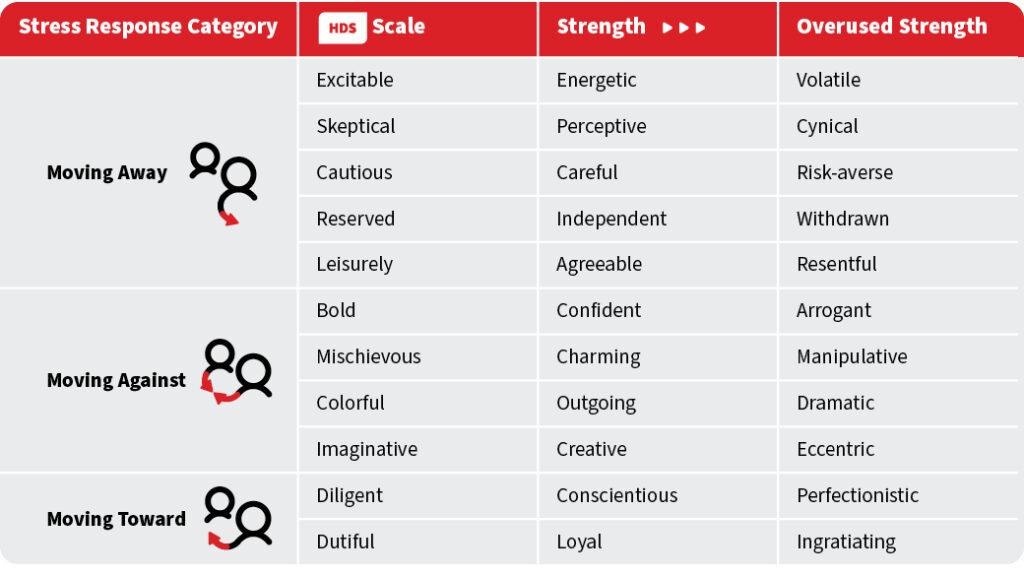
When overused, your greatest strength can be your greatest weakness.
Self-Reflection – the Key to Sustainable Leadership
Personality can be understood from two perspectives: identity (how we see ourselves) and reputation (how others experience us). When these two perspectives are far apart, leaders may overlook feedback, underestimate risks, and stall in their development. Strategic self-awareness helps leaders use their strengths appropriately, recognize patterns, and adjust behavior intentionally. Changing behavior is challenging—but it is possible when development is clearly structured and professionally supported.
How to Strengthen Leaders in a Targeted Way
Organizations benefit significantly when they view derailers not as risks, but as opportunities for development. Key steps include:
- using validated diagnostic tools (HDS, 360-degree feedback)
- presenting results in a clear and actionable way
- creating individualized development plans
- offering coaching to support behavior change
- tracking progress over time
Successful leadership programs also include regular reflection cycles and clear accountability. This creates a culture in which leaders can grow—and, in turn, enable their teams to perform at their best.
Conclusion
When strengths turn into risks, teams lose direction and organizations lose effectiveness. With a clear talent strategy that combines personality assessment, coaching, and continuous development, organizations can secure leadership potential over the long term and reduce avoidable risks. What helps leaders rise should not be what causes them to fall.
Take action now!
Related articles
Mavie editorial team
HOGAN Assessments: Better Talent Decisions & Leadership
Hogan Assessments reveal how people work – in everyday situations (HPI), under pressure (HDS), and based on their core values and motives (MVPI). This enables predictive and fair decisions in recruiting and talent development: fewer hiring mistakes, fewer leadership risks, and more stable teams. Hogan is used worldwide, available in more than 50 languages, and links personality data with real performance indicators — continuously supported by new validation studies.

Mavie editorial team
Vom High Performer zum Owizara: Gedanken zur Arbeitsmotivation?
Motivation im Job: zwischen Engagement und Resignation. Wir stellen uns die Frage, warum viele Arbeitnehmer:innen mit hoher Motivation in den Job starten, diese jedoch mit der Zeit verlieren. Während Sinnhaftigkeit und gute Führung langfristig motivieren, sorgen Stress, schlechte Firmenkultur und fehlende Kommunikation oft für Demotivation.

Mavie editorial team
Was Mental-Health-Benefits für Unternehmen bringen
Für 87 % der Arbeitnehmer:innen steigern Mental-Health-Benefits die Attraktivität eines Arbeitgebers. Was sind die effektivsten Mental-Health-Benefits und wie unterstützen Sie konkret den Unternehmenserfolg?

Mavie editorial team
Der erfolgreiche Weg zu mehr Work-Life-Balance
Work-Life-Balance ist ein Schlagwort, das aus unserem modernen Arbeitsleben nicht mehr wegzudenken ist. Doch was verstehen wir eigentlich darunter – und wie ist es in Zeiten von steigenden Anforderungen am Arbeitsplatz möglich, eine gesunde Balance zwischen Arbeit und Privatleben zu erreichen?
